Towards the cradle of the Renaissance and the industrial heartland
Audio description of the artwork
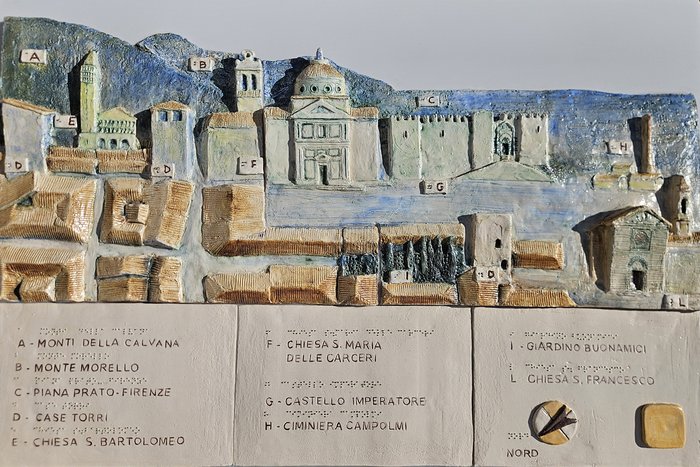
A – Monti della Calvana
Silent witnesses to the millennia-old history of the Prato area: on the slopes of the Pizzidimonte hills between Prato and Calenzano, the ‘Offerente’ – a small Etruscan votive bronze statue now housed in the British Museum – was discovered in 1735.
B – Monte Morello
The imposing, isolated hill that dominates the horizon towards Florence, in an area rich in watercourses, springs and historical sites.
C – Prato-Florence Plain
The vast plain stretching to the east of the city links Prato and Florence. On the clearest days, one can make out the unmistakable silhouette of Brunelleschi’s dome on Florence Cathedral.
D – Tower Houses
In Via Pugliesi there are two medieval towers: the Torre dei Giudei, known as the ‘Torre della Buca’, and the Torre degli Ammannati. Meanwhile, in Piazza Sant’Antonino stands the Torre dei Ginori.
E – Church of San Bartolomeo
The church, with its tall bell tower, stands in the spacious Piazza Mercatale. It was rebuilt in the 1950s following the devastating bombings of the Second World War. Also destroyed in 1944 was Filippino Lippi’s famous “Tabernacolo del Mercatale”, which had stood on the corner of the square since the late 15th century; its frescoes, saved and restored by the Prato-based restorer Leonetto Tintori, are now on display in the museum.
F – Church of Santa Maria delle Carceri
This church was built at the end of the 15th century at the behest of Lorenzo the Magnificent, on the site of a medieval prison, the ancient cells of which can still be visited today. The complex is characterised by a central dome and an elegant 18th-century bell tower. According to tradition, in 1484 an image of the Virgin Mary performed a miracle in this church by coming to life before a child.
G – The Emperor’s Castle
This majestic medieval fortress stands out as the only example of Swabian architecture in central and northern Italy. The castle was built at the behest of Emperor Frederick II of Swabia at a strategic point controlling the imperial road. In the past, it was connected to the Cassero, a ‘corridor’ erected by the Florentines in the 14th century to allow them to move unnoticed between the castle and the city walls and vice versa, with the aim of controlling and governing the city.
H – Campolmi Chimney
The former chimney is situated in the historic centre within the medieval walls and was Prato’s largest 19th-century factory. It was only when textile production ceased in 1994 that the building was redeveloped as a municipal cultural centre, now housing the Textile Museum and the Lazzerini Library.
I – Buonamici Garden
Now the seat of the Provincial Administration, the roof garden of Palazzo Banci Buonamici is an intimate green retreat where traces of ancient medieval structures emerge amongst the vegetation.
L – Church of San Francesco
One of the city’s principal religious buildings and part of the tradition of the mendicant orders, alongside San Domenico and Sant’Agostino. Of medieval origin, the church is characterised by the simplicity of its red-brick structure, typical of Franciscan architecture. Its elegant façade, featuring two-coloured bands of Alberese stone and serpentine, is particularly striking. Inside the church, the white marble tombstone of Francesco di Marco Datini, a famous 14th-century merchant from Prato, is preserved.