Amidst industrious valleys, green marble and ancient cloisters
Audio description of the artwork
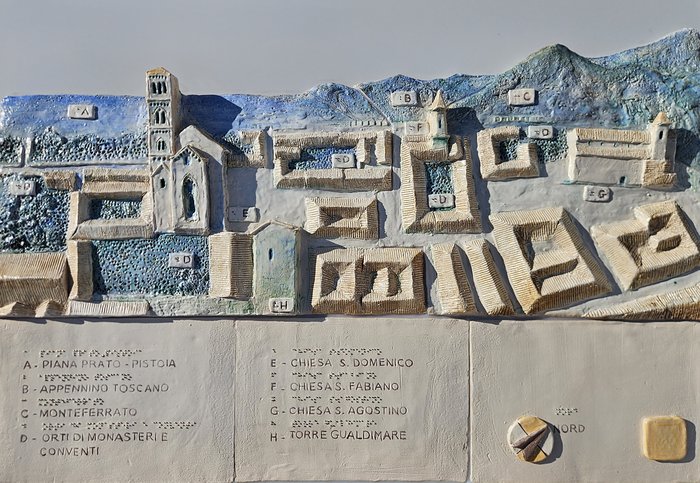
A – Prato-Pistoia Plain
The westernmost part of Prato is a flat plain bordered by the Pistoia Mountains to the north and Montalbano to the south.
B – Tuscan Apennines: the hills silhouetted against the city’s backdrop form part of the Tuscan Apennines, characterised by high biodiversity and peaks exceeding 2,000 metres in altitude.
C – Monteferrato
The extensive hilly area stretching between the municipalities of Prato,
Vaiano and Montemurlo is home to the Monteferrato Protected Natural Area. The hilly landscape is recognisable by three gently sloping peaks: Poggio Ferrato, Monte Mezzano and Monte Piccioli. Serpentine, the green marble typical of Prato, was quarried from these hills, particularly in the Figline di Prato area.
D – Monastery and convent vegetable gardens
In the western part of the city lie extensive vegetable gardens and gardens belonging to the complexes of San Niccolò, San Vincenzo and San Clemente, which ensured the self-sufficiency of the religious communities whilst providing places for contemplation and work. The monasteries often housed women from noble Florentine families, who led a cloistered life there. Saint Catherine de’ Ricci, co-patron saint of Prato, lived in the monastery of San Vincenzo alongside Saint Stephen.
E – Church of San Domenico
This imposing Gothic brick building was one of the centres of the Order of Preachers. Within these walls, in 1496, Girolamo Savonarola preached; in his fiery sermons, he prophesied the terrible Sack of Prato in 1512. To its right lies the square of the same name, Piazza di San Domenico.
F – Church of San Fabiano
With its distinctive terracotta bell tower, it is one of the city’s oldest churches, first documented in 1082 as an abbey and a place of welcome for pilgrims and the sick. Inside, it houses an extremely valuable mosaic floor dating back to the 11th century.
G – Church of Sant’Agostino
The building was founded by Augustinian monks in 1270. The large square in front of it, a characteristic feature of churches belonging to the Order of Preachers, was designed to accommodate a large number of worshippers during sermons and public celebrations.
H – Gualdimare Tower
This ancient 12th-century tower-house is situated on Via Cesare Guasti and originally formed part of the gate of the same name in the city’s first set of walls; it was only incorporated into the urban fabric following the construction of the 14th-century walls.